
Dekalog, or The Ten Commandments in Downtown Warsaw: Part 1
Engendering Self-Examination (for Francesca Albanese, UN special rapporteur for the West Bank and Gaza)

“Our whole life is startlingly moral. There is never an instant’s truce between virtue and vice.”
—Henry David Thoreau, Walden
“The road from appearance to reality is often very hard and long, and many people make only very poor travelers. We must forgive them when they stagger against us as if against a brick wall.”
—Franz Kafka, in Gustav Janouch’s Conversations With Kafka
“And be not in haste to recite a revelation of the Quran, O Prophet, before it is properly conveyed to you, and pray, “Lord, increase me in knowledge.”
—The Quran, 20:114
“For we are like olives: only when we are crushed do we yield what is best in us.”
—The Talmud
A Sort of Introduction
Acclaimed Polish director Krzysztof Kieslowski’s most sublime work, arguably, is Dekalog, a series of ten one-hour films originally made for Polish television, each corresponding loosely to one of the Ten Commandments. Decalog is cherished by cinephiles as a masterpiece of world cinema. All of the films are shot in and around a single apartment complex—one of the more fashionable in Warsaw at the time of their creation, yet simple, even austere, by Western sensibilities and tastes. As we watch, we become aware of an eerie interplay between persons and events, protagonists in one film making unexpected, albeit fleeting, appearances in some of the others. “A poetic universe,” writes film scholar Annette Insdorf, “of convergences.” An enigmatic character appears briefly in all but one of the films, remaining silent throughout while functioning as a witness in observing all that occurs while influencing nothing. His presence, observes Kieslowski, is meant to “engender self-examination.” He is, perhaps, our collective sense of conscience, a biblical “the still, small voice” for those within earshot of inward Kafkan trial and truer jihad.
“His camera shows a destroyed world—not just the physical landscape but the human. In terms of Polish art, this is a new form of melancholy—not despair, but a deep melancholy where every act is drained of meaning. His films [are] a kind of intellectual and spiritual cleansing for viewers accustomed to seeing the world through images approved by the government.”
—Josef Tischner, Polish priest and philosopher commenting on Kieslowski’s work and invoking Auschwitz as the context out of which it emerged
“If I had to formulate the message of my Dekalog, I’d say, ‘Live carefully, with your eyes open, and try not to cause pain.’”
—Krzysztof Kieslowski
Sugarloaf Drive once upon a time
It has been more than forty years since a serene summer evening in the Tiburon hills overlooking San Francisco and the East Bay during which Rollo May shared some thoughts with a small cadre of students on the primordial theme of good versus evil along with cautiously expressed hopes for a better possible life experience and space. May saw many things about which to feel sanguine yet offered only a fifty percent chance of safe passage. I sat next to him and listened intently. It was a free-ranging discussion toward the end of a series of seminars (“Socratic discussion” was the phrase Rollo liked to employ) during which we read through May’s books while discussing them then in his graceful yet modest home on Sugarloaf Drive.
Rollo opined at some length about signs of life he discerned among the young, dissatisfied as they were with business as usual and eager for substantive change. He held out hope, albeit reservedly, even for prospects that might accrue with technological advance. He mentioned the landing on the moon by the astronauts of Apollo 11 (and the vision there of a blue water planet called Earth floating tentatively in space and unfettered by political divides) as a kind of metaphor for a more harmonious future politic, mythology, and world. I listened with increasing perplexity, finally exclaiming that I did not share his vision or see quite so much reason for hope.
Rollo misconstrued by comments at first, presuming that his remarks might seem too circumspect and reserved for fledgling psychologists of tomorrow. He related, touchingly, that my (misperceived) optimism brought to mind a conversation he had had many years earlier with his mentor, the German philosopher and theologian Paul Tillich, noting that he, too, had once partaken of a perhaps necessary naiveté of youth. I was moved by his superimposition of the then present moment (a moment already so many years past!) on that earlier imprint of his own student/mentor relationship with Tillich. I corrected him, however, after which he exclaimed, “So you are more pessimistic than I.” “Yes,” I confessed. “Well, that’s because you’re a Jew,” he rejoined; “You know what I mean, don’t you?” Intuitively, I think, I did. Rollo paused just long enough, however, to more clearly make his point. “It’s because the Jews have taken it on the chin so many times.”
May was suggesting, it seems, that—with its bible of woe and tales of growth through suffering (without assurance of good news at the end of the line) and macabre recent history—the Jewish people might have garnered through the generations a certain collective insight into the darkened aspects of human nature. The uses of adversity had always been one of May’s bedrock themes. I have encountered this sort of insight into suffering and awareness in countless Palestinian poets, filmmakers, journalists, and knowing civilians over time (far more than a few of whom have not survived still ongoing barbarities) likely for similar reasons. I have witnessed this conjoined feeling for suffering and compassion in severe mental illness as well. May returns regularly through his work to Hannah Green’s autographical novel, I Never Promised You a Rose Garden—even in his final book, The Cry for Myth. The stakes, after all, are exceedingly high, and the planet would appear to be running precipitously out of time.
A Hebraic reverie, then, upon good and evil? Really, I intend no such thing. Rather, intimations of conscience and character that are uniquely my own and for which no race, creed, or religion need take responsibility beyond normative insights and limits. A collage of sorts the contours of which will, I hope, become clearer over time. Moving beyond the neatness of theory (philosophical/theological/professional abstraction), we confront our very selves. For May and Kieslowski, such self-examination is always the bottom line. Is there a better way to inquire into inmost things?
Character and psychotherapy
Frieda Fromm-Reichmann was, along with their mutual mentor, H. S. Sullivan, one of the two finest therapists Rollo May ever knew, though he recalled her as diminutive, awkward, and unprepossessing. In Hanna Green’s autobiographical novel, I Never Promised You a Rose Garden, a psychotic girl recounts the course of her work with this tiny doctor “known and loved by madmen the world over.” It is the strength of Fromm-Reichmann’s character—and also her patient’s—against a backdrop of everyday indifference and even treachery that allows Deborah to gradually emerge from an inner world of “Yr” (a self-created realm once offering succor yet now threatening to consume), the relationship itself a paragon of unselfconsciousness, engagement, humor, and care:
“Show me,” she said. “Show me the arm.”
Deborah undid the sleeve, burning with shame.
“Wow!” The doctor said in her funny, accented colloquial English. “That’s going to make a hell of a scar!”
“All my dancing partners will wince when they see it.”
“It is not impossible that you will dance someday, and that you will live in the world again. You know, don’t you, that you are in big trouble? It’s time to tell me fully what brought you to doing that business there.”
She was not frightened, Deborah saw, or horrified, or ridiculing, or making any of the hundred wrong expressions that people had always shown in the face of her trouble. She was only completely serious. Deborah began to tell her about Yr.
—Hannah Green, I Never Promised You a Rose Garden
Deborah has that eerie precocity we often find in childhood and early madness. (“I’m sorry I’m young,” she tells an older veteran of the wards with mock contrition; “We have the right to be as crazy as anyone else.”) And there is, too, a penchant for metaphor and yearning for justice in a frequently brutal and cruelly unjust world. During one particular session, Deborah tells her doctor (affectionately christened “Furii” in a gesture that movingly personalizes a relationship that will become for awhile her very lifeline and hope) about an incident on the ward involving staff impropriety and about which she has complained without administrative acknowledgement or response:
At last Furii agreed to mention it in the staff meeting, but Deborah was not convinced. “Maybe you doubt that I saw it at all.”
“That is the one thing that I do not doubt,” the doctor said. “But you see, I have no part in what is to be done on the wards; I am not an administrative doctor.”
Deborah saw the match lighting dry fuel. “What good is your reality, when justice fails and dishonesty is glossed over and the ones who keep faith suffer?”
“Look here,” Furii said. “I never promised you a rose garden. I never promised you perfect justice . . .” (She remembered Tilda suddenly, breaking out of the hospital in Nuremberg, disappearing into the swastika-city and coming back laughing that hard, rasping parody of laughter. “Shalom aleichem, Doctor, they are crazier than I am!”) . . . “and I never promised you peace or happiness. The only reality I offer is challenge, and being well is being free to accept it or not at whatever level you are capable. I never promise lies, and the rose-garden world of perfection is a lie . . . and a bore, too!”
I Never Promised You a Rose Garden: A Novel by Hannah Green
With such forthrightness and lack of pretense does a therapeutic connection evolve and Deborah’s “Yr” voice with its incessant refrain (“You are not of them”) gradually recede as she learns that it may yet be possible to trust what is known, in the lexicon of Yr, as an “earth-one.” Slowly Deborah, a long-suffering “veteran of many deceits,” learns to inhabit a middle ground between worlds within and without, coexisting with myriad sinister aspects even of a purportedly rational world psyche and space.
Musical Coda
Nina Gerber (who we have already briefly met in this Rollo May Consortium) is the guitarist who accompanied beloved Bay Area folksinger Kate Wolf on so many seminal performances and recordings. In a recent interview, Gerber speaks about how Wolf’s voice, songs, and presence seized her attention from very early on after being cajoled by a friend to listen to Wolf perform at a local pizzeria while still in her teens. (I believe I have already shared having spotted one of Wolf’s albums in Rollo’s living room—a gift from a treasured folksinger for an author she evidently admired. As I have noted, a link between folk traditions and the humanistic impulse is longstanding. “We all play folk music,” Thelonious Monk informed a youthful Bob Dylan very early on.) Gerber has remained an unassuming and enormously respected West Coast musician ever since Wolf’s death shortly after being diagnosed with leukemia.
"It is so Zen the way she undergirds and complements whatever music is at hand, never playing an extraneous or superfluous or irrelevant note & always being perfectly in the flow with whatever she is playing & whomever she's playing with! Playing Music together on that level is Divine!”—Maria Mulduar
"Nina has this uncanny ability to weave an emotional tapestry throughout a song . . . never getting in the way of the song, but adding this incredible depth . . . I am just amazed at what I hear coming from her side of the stage."—Karla Bonoff
Gerber neither writes her own songs nor sings. Rather, she plays guitar in a manner that is both understated and ultimately sublime, graciously serving the moment and musician at hand. It’s something Kate Wolf must have intuited early on. Here she covers John Lennon’s Imagine before segueing into We Shall Overcome (a gospel song of unknown origins forever associated with the civil rights movement in a United States that remains far from having unequivocally honored any sort of Decalog during the long unfolding of its personal daemons and history) in order to convey a wordless reminder of our better angels and selves. Messages of critical relevance right about now in ways that will be immediately apparent (along with those of Francesca Albanese, who seems to have upset newspeak authorities in documenting the inconvenient truth that state-sanctioned murder may be highly profitable) to anyone within earshot. Urgent counterpoints to an Orwellian doublespeak with which one collides whichever direction one turns. “War is Peace,” “Freedom is Slavery,” “Ignorance is Strength,” “Concentration Camp is Humanitarian City.” The Fender Stratocaster Nina plays was given to her by Nanci Griffith after sitting in on sessions with Griffith’s Blue Moon Orchestra. It is, along with the David Matlin acoustic gifted by Wolf herself shortly before passing away, an especially cherished instrument.
Photography credit
In an earlier Rollo May Consortium post, Life Conduct in Modern Times, A Prelude, I wrote about the legendary jazz artist, John Coltrane:
“On a tour through Japan the year before his death (during which Coltrane visited Buddhist temples and war memorials in both Hiroshima and Nagasaki and wondered who the famous dignitary or movie star on board the airplane might be as he debarked to meet the banners and cheering throngs), the jazz artist was interviewed. Asked about his religion, he responded with wisdom, insight, and tact:
“I am [Christian] by birth; my parents were and my early teachings were Christian. But as I look upon the world, I feel all men know the truth. If a man was a Christian, he could know the truth and he could not. The truth itself does not have any name on it. And each man has to find it for himself.”
Asked about the future, Coltrane rejoins: “I believe that man is here to grow into the fullest. As I am growing to become whatever I become, this will just come out on the horn.” Asked what he planned to do in the next ten years, Coltrane answers in apparent earnest: “Become a saint.”
Coltrane seems to have attained a trans-denominational saintliness after all. His final years were typified by an almost otherworldly clarity of comportment and purpose. References to Islam are frequent in Coltrane’s work. Naima, his first wife, was a devout Muslim, as was his astonishingly brilliant pianist, McCoy Tyner. His wife and eventual collaborator, Alice, was deeply and genuinely spiritual as well and, like her husband, an astonishing musician.
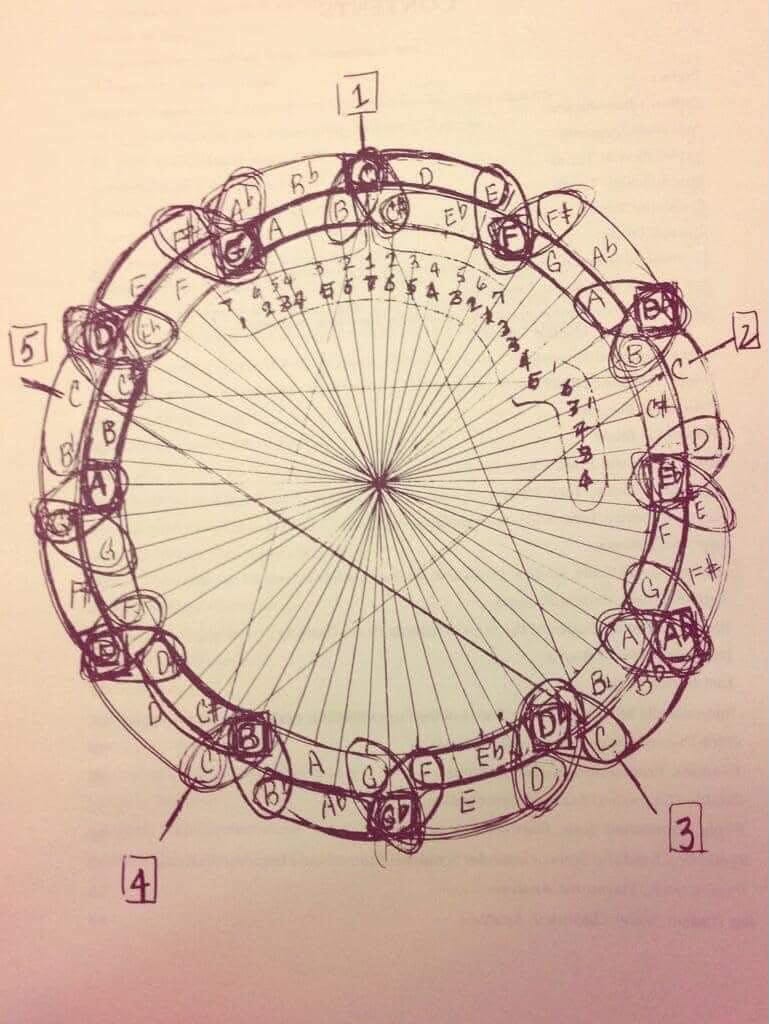
The sketch known as “Coltrane’s Circle of Tones” was made sometime in 1967, the last year of Coltrane’s life. According to close friend and fellow reedman, Yusef Lateef (to whom Coltrane gave the drawing), it expresses Coltrane’s understanding of the mathematical “structures of music.” Structures relevant to scientific discovery and spiritual inquiry alike. Both avenues of pursuit, suggests Lateef, are “intuitive”processes that “come into existence in the mind of the musician through abstraction from experience.” Intriguingly, these are precisely the themes Rollo May wished to guide a center in his name that was, in fact, funded before he died but effected only nominally and in superficial ways he would have vociferously opposed. This Rollo May Consortium seeks to set things more nearly right in pursuing matters of substance during a bleaker moment in time than even May himself might have ever imagined. A unique aspect of May’s gift as a “thinker” was his ability to balance despair and tragedy with a resoluteness and hope that aspires to be neither hackneyed nor naive. In a phrase, we are evoking the courage not merely to persevere but even create in and out of the midst of daunting travail.
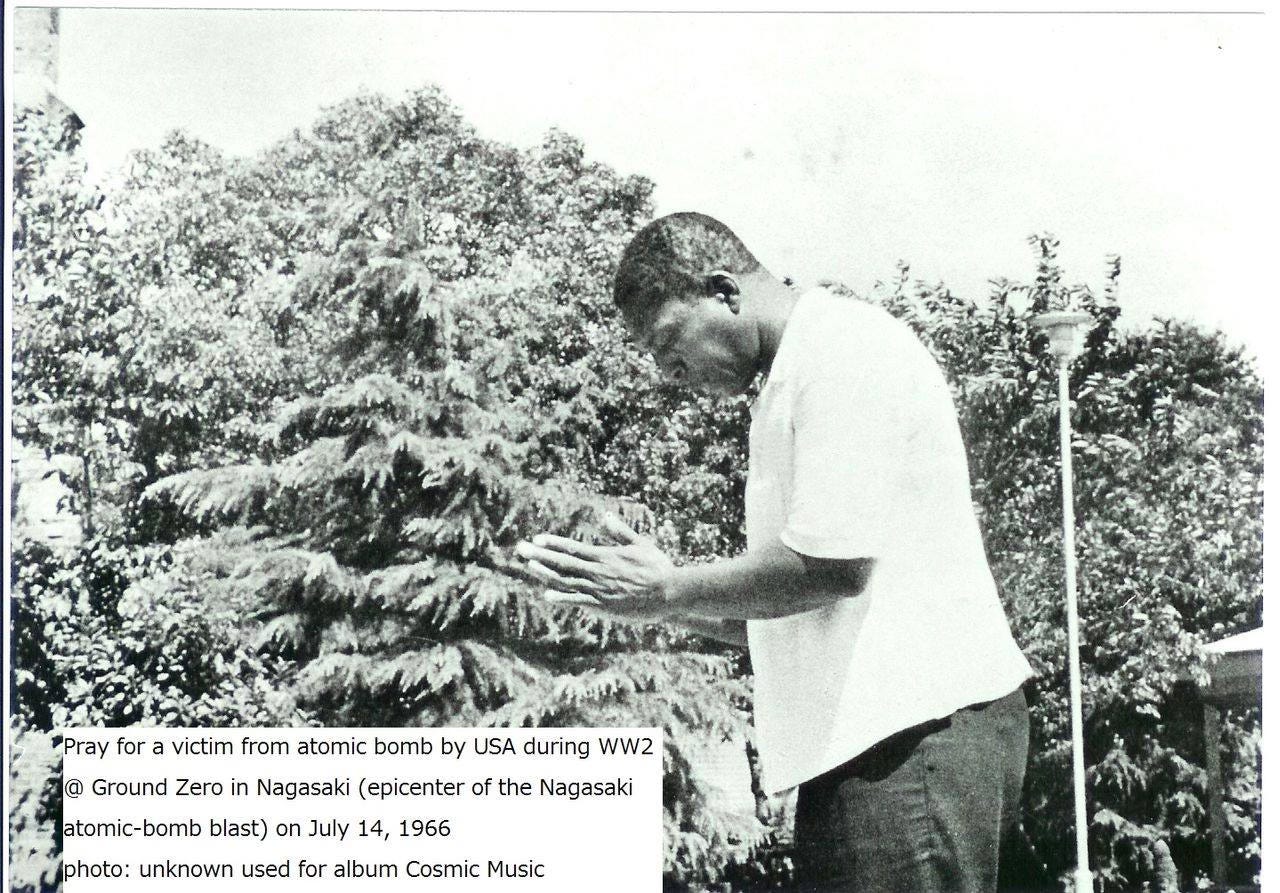
In the photograph above taken by an apparent passerby, Coltrane prays at the War Memorial Park in Nagasaki, a space dedicated to the memory of the countless lives lost in the aftermath of the detonation of the atomic bomb on August 9th, 1945. By all accounts, the tour was a grueling ordeal during which the band played a total of seventeen concerts in only two weeks. Coltrane’s recently composed Peace on Earth was one of the songs performed along the way—music described as “beautiful, abstract, and beatific.” Other photos taken en route disclose a man with his hand placed on his abdomen in apparent pain or discomfort. Coltrane would succumb to liver cancer at the age of forty exactly one year further downstream in this Thoreauvian river we “earth-ones” call Time.
References
Green. H. (1964). I Never Promised You a Rose Garden. Holt, Rinehart, & Winston.
Insdorf, A. (1999). Double Lives, Second Chances: The Cinema of Krzyzstof Kieslowski. Hyperion.
Kafka, F, (1999). The Blue Octavo Notebooks (E. Kaiser and E. Wilkins, trans.). Exact Change.
Kieslowski, K. (1987). Decalog. Poland: Ryszard Chutkowski/Polish Television.
Janouch, G. (1971/1985). Conversations with Kafka (G. Rees, trans.). Quartet Books.
May, R. (1976). The Courage to Create. Norton.
Lateef, Y. (2015). Repository of Scales and Melodic Patterns. Alfred Music.
Thoreau, H. D., (1854/1996). Walden. Konemann.