
DEKALOG, or The Ten Commandments in Downtown Warsaw, Part 4: "Midrash" or Commentary
Intimations of Character

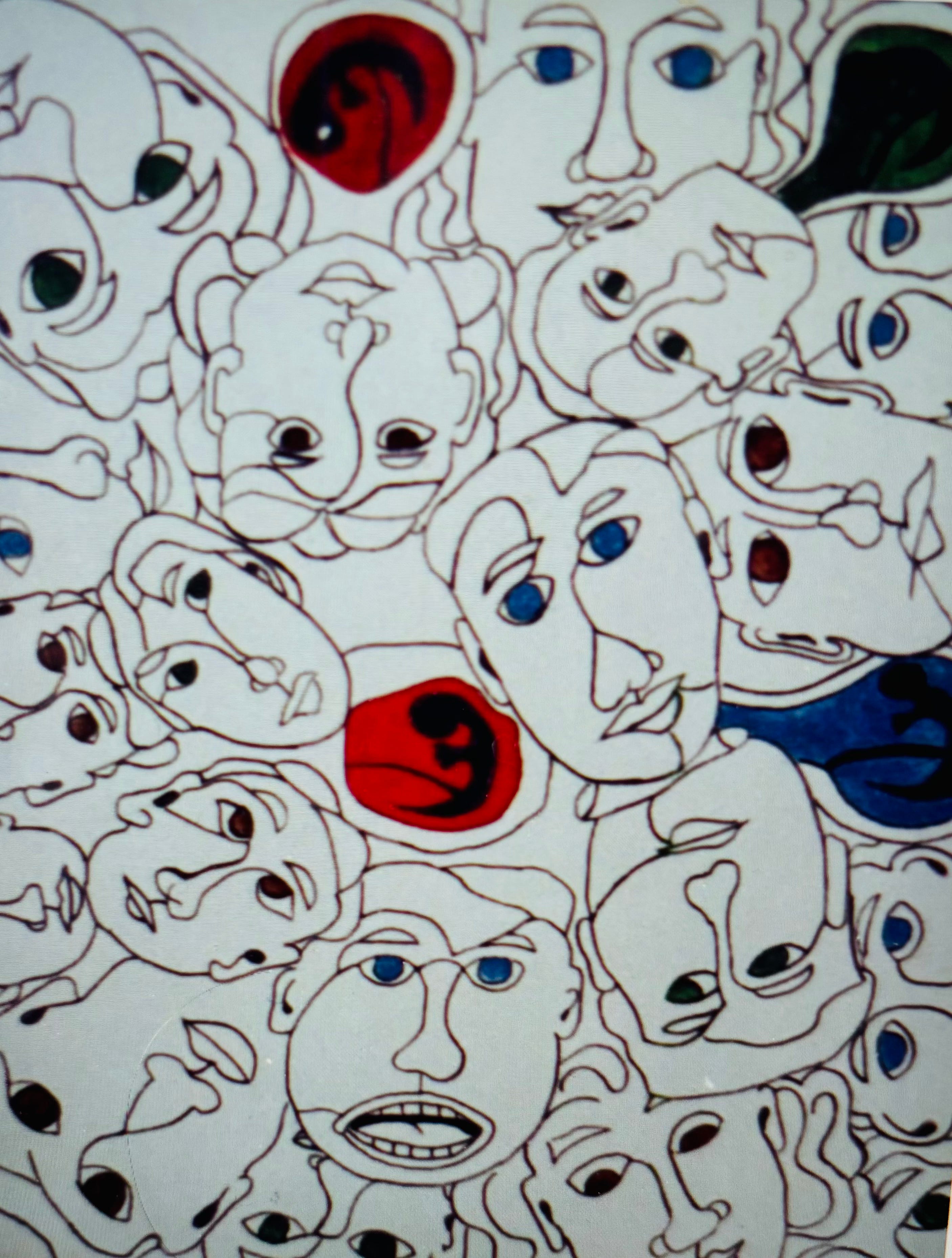
The 4th installment of DEKALOG, or The Ten Commandments in Downtown Warsaw, opens with Kristyna’s evocative painting, “Who to Become?” It’s a matter of utmost concern for each of us, really. Certainly in youth, but at critical moments in our subsequent lives also. To say nothing about the lives of the cultural milieus out of which we emerge and attempt to persevere as best we can.
Rollo May was fascinated by those Kierkegaardian “pregnant moments” in our personal lives no less than in the narratives of our nation states and greater world. Authentic self-inquiry and ongoing striving for integration of the self, May suggests in Man’s Search for Himself, require crisis. Avoidance of depth, nuance, and Kundera’s “spirit of complexity” is, in the end, distraction resulting in frustration at the very least yet, generally, far worse. Thus, the attentiveness Kieslowski strives to engender in his film cycle via a spirit of “self-examination.”
Consortium readers should note the four fetuses in Kristyna’s painting, two that are red and two that are blue. They represent the four domains or “houses” of Kristyna’s inner world. “Action” and “reaction,” the inner guide Cara explained to me at the time of their rendering: “blood” and “tears,” trauma and heartache. Dissociation, unlike mood disturbance, is a function of trauma far more than biology, though the two worlds of experience sometimes converge. Abuse of an explicitly sexual nature is, unfortunately, a regular occurrence. Similarly, the incidence of dissociative identity is high in war torn places across the globe. Kristyna grew up in a home of rabid abuse cloaked in a pretense of religious self-righteousness. By imagining into being alternate selves with which to inhabit an alternative universe, she was able to somehow survive the macabre circumstances into which she had been unjustly cast, albeit at tremendous personal expense. Both in words and images, she has much to teach us along the psycho-spiritual inclines. John Urbain, the collage artist whose work accompanies so many of these Consortium posts, was fascinated by Kristyna. He encouraged her to keep exploring her myriad selves and heartrending story through writing and art.
In an earlier post on Kieslowski’s hallowed film cycle, we noted the filmmaker’s similar insistence on self-inquiry if one is to come more fully into one’s own in the telling of stories and living of life:
“I keep persuading younger colleagues . . . to examine their own lives. Not for the purposes of any book or script but for themselves. I always say to them, try to think of what happened to you which . . . led to your sitting here . . . on this very day . . . What really brought you here? You’ve got to know this. That’s the starting point.
“The years in which you don’t work on yourself . . . are, in fact, wasted. You might feel or understand something intuitively and, consequently, the results are arbitrary. It’s only when you’ve done this work that you can see a certain order in events and their effects.”
—Krzysztof Kieslowski, Kieslowski on Kieslowski
Do you see? Exactly my late artist friend’s advice to Kristyna—and May’s to his disciples as well.
Dylan’s Murder Most Foul is an extended reverie befitting a time of conspicuous ambiguity and bloodletting while recounting the assassination of JFK on November 22, 1963. I recall reading somewhere that the Old Testament does not especially distinguish between prophet and poet. Both identities tap into nonlinear, even non-rational, aspects of consciousness and in this way converge. Jesus and Muhammad have much of the poet in them as well.
Dylan, still a very young man at the time of JFK’s assassination, has recently announced his One Last Ride tour, set to begin next year (replacing the “Never-Ending Tour,” which commenced in 1988). It will be his last. It’s difficult to convey the significance of this moment in what has been, from very early on, an astonishingly fertile imagination and creative life. Upon Dylan’s receipt of the Nobel Prize for Literature in 2016, Leonard Cohen spoke for multitudes of literati and fans, likening the honor to “pinning a medal on Mount Everest for being the highest mountain.” Perhaps it is Nietzsche who somewhere muses that the proper response to genius is love.
“What is the truth, and where did it go?
Ask Oswald and Ruby, they oughta know”—Bob Dylan, Murder Most Foul
Dylan’s reverie on both person and event in the aftermath of JFK’s death is associative, contemplative, and appropriately vague. It’s also genuinely mournful, something I didn’t especially discern in the manifold, often strident pronouncements attending the recent death and memorial service for Charlie Kirk. Dylan ponders a nation’s loss of innocence and, potentially, its very soul no less than the place of Truth and Beauty in a world in which such attributes appear so often to be on the wane. (“Righteousness,” child psychiatrist Robert Coles advises in a radio interview, “not self-righteousness.”) Arguably, the gaping distance between these two public events reflects just how much we and the world have changed.
In The Art of the Novel, Milan Kundera reflects forebodingly on apocalypse and a world void of poetry:
“It’s some time now since the river, the nightingale, the paths through the fields have disappeared from man’s mind. No one needs them now. When nature disappears from the planet tomorrow, who will notice? Where are the successors to Octavio Paz, to Rene Char? Where are the great poets now? Have they vanished, or have their voices only grown inaudible? In any case, an immense change in our Europe, which was hitherto unthinkable without its poets. But if man has lost the need for poetry, will he notice when poetry disappears? The end is not an apocalyptic explosion. There may be nothing so quiet as the end.”
—Milan Kundera, The Art of the Novel
As for Dylan, it’s moving to see the 84 year old bard speak out recently (if media accounts are to be believed) about events of our current day—something he’d done with extraordinary skill and eloquence throughout his youth. About the cancellation and subsequent reinstatement of Jimmy Kimmel, he reportedly said or wrote: “Disney and ABC think bringing Jimmy Kimmel back will calm us? No. This isn’t about one show—it’s about the freedom and creativity of an entire generation. When the right to speak is suffocated, art withers, and we step into an age of darkness.” Where will we be without our poets, our prophets in a world in which marginalized persons, ethnicities, and voices are callously disenfranchised and silenced?
Dylan’s thoughts dovetail, again, with those articulated by Rollo May in The Courage to Create:
“We are called upon to do something new, to confront a no man’s land, to push into a forest where there are no well-worn paths and from which no one has returned to guide us. This is what the existentialists call the anxiety of nothingness. To live into the future means to leap into the unknown, and this requires a degree of courage for which there is no immediate precedent and which few people realize.”
—Rollo May, The Courage to Create
The phrase “Murder Most Foul” is, of course, found in Shakespeare’s Hamlet:
Now, Hamlet, hear. Tis given out that, sleeping in my orchard, A serpent stung me. So the whole ear of Denmark Is by a forgèd process of my death Rankly abused. But know, thou noble youth, The serpent that did sting thy father’s life Now wears his crown.
—Hamlet (Act 1, Scene 5)
The world has changed seismically since the 1960s. And, yet, an insidious, seemingly inexorable scheming goes on behind the scenes of some of our most tectonic public events, which tend often to remain shrouded in mystery. This is the sense in which the machinations of human nature and world haven’t changed at all. Hamlet is uncertain as to whether his father’s ghost tells the truth about his death. Torn between belief and doubt, he resorts (not unlike Dylan, or, indeed, Kristyna) to an exercise of the imagination (the writing of a play within the play) in attempting to understand just what has gone down.
Jacqueline Kennedy Onassis came to believe that LBJ was responsible for her husband’s death. Like so many who crave power, Johnson could be ruthless in its pursuit. On the theme of ambiguity, this is not to deny that he was able to rise to certain political—-and, moreover, moral—moments, something concerning which we see alarmingly little evidence forthcoming from the vast majority of elected officials today. There is considerable evidence linking Johnson to a number of other Texan murders including, conceivably, even a sister who simply may have known too much. There are those who believe, not without reason, that the recent murder of Kirk may, likewise, have been an inside job. Who to become? indeed.
It’s not for no reason that Melville entitled his penultimate novel, Pierre, or the Ambiguities. Sometimes called the great 19th century American psychological novel, it is also the book that put Melville more or less out of business as an author. Audiences then, as now, wanted to be entertained rather than guided into the infinite complexities that inhere in Cosmos and Self. There are suggestions, albeit no explicit proof, linking Israel (a self-proclaimed Jewish state and, recently, perpetrator of heinous slaughter) to the taking out of an American president and, possibly, his younger brother, Robert, as well.
And, so, the literary and thinking worlds may count their blessings that Kieslowski ran into his co-scriptwriter Krzysztof Piesiewicz in downtown Warsaw one chilly morning in the mid-80s when the idea for a film cycle inspired, loosely, by the Ten Commandments was first hatched. Legendary director Stanley Kubrick put it this way:
“I am always reluctant to single out some particular feature of the work of a major film-maker because it tends inevitably to simplify and reduce the work. But in this book of screenplays by Krzysztof Kieslowski and his co-author, Krzysztof Piesiewicz, it should not be out of place to observe that they have the very rare ability to dramatize their ideas rather than just talking about them. By making their points through the dramatic action of the story they gain the added power of allowing the audience to discover what’s really going on rather than being told. They do this with such dazzling skill, you never see the ideas coming and don’t realize until much later how profoundly they have reached your heart.”
—Stanley Kubrick on the films of Kieslowski and Piesiewicz
Consortium readers can follow the link below to find an excerpt from an excellent documentary about Kieslowski, I’m So-So, made late in the director’s life, along with reverent endorsements of the man and his work from the likes of Julie Delpy, Roger Ebert, and others. Ebert’s admiration for the filmmaker and his hallowed film cycle is palpable. Believe it or not, it was Ebert, a film critic, who first wrote about singer-songwriting legend John Prine. A very different kind of artist yet equally special and for similar reasons. In each case, it’s all about the telling of stories and human heart.
Krzysztof Kieslowski, a giant of the cinema and a crusader for humanity
Musical Codas, i and ii: Ballad of a Thin Man, The Lonesome Death of Hattie Carroll
“Anxiety occurs at the point where some emerging potentiality or possibility faces the individual, some possibility of fulfilling [one’s] existence; but this very possibility involves the destroying of present security, which thereupon gives rise to the tendency to deny the new potentiality.”—Rollo May, The Discovery of Being
Bob Dylan both thrilled and tormented innumerable fans by going “electric” in the mid-1960s with the backing of a Canadian group that would come be known, simply, as The Band. This performance of “Ballad of a Thin Man” (“Something is happening here/But you don’t know what it is/Do you, Mr. Jones”) from Highway 61 Revisited, first released in 1965, took place in Newcastle, England the following year. What is striking is the sheer manic exuberance coexistent with a startlingly novel articulation of the chaos, pretense, and madness pressing on all sides as Dylan descends into a maelstrom of infinitely restless times.
This music was, no doubt, a sea change from an equally transfixing sound that had typified Dylan’s so-called “acoustic” period, which had birthed those spellbinding “protest songs” of the early 60s, stunning a nation and greater world. Audiences wanting only to be consoled by familiar folksongs of romance, wellbeing, or even “finger-pointing” (the term Dylan used to describe his "protest songs”) were bewildered and often irate, as can be seen in the following video. Only those sufficiently “within hearing distance” were able to get the message: all was not right with the world (something was, indeed, “rotten in the state of Denmark”), and that a entirely new expression of things was, perhaps, just what the gods ordered. The feeling of a generation in search of its prophet or voice is palpable in listeners’ emotional, often outraged, reactions to this rivetingly new embodiment and sound.
The Lonesome Death of Hattie Carroll
Dylan tapped into the theme of injustice early on in life and was especially taken up with the interrelated matters of racism and civil rights in America. Hattie Carroll was a 51 year old African American woman working as a barmaid when she was slain at a “white tie Spinsters’ Ball” at the Emerson Hotel in Baltimore by a young, inebriated white man named William Zanzinger. Although the killing appears to have been inadvertent, Carroll’s belligerent, drunken assailant (a 24 year old man raised with material privilege on a tobacco farm owned by wealthy parents) surely meant her no good. Dylan’s song is both poignant and stunningly direct. The pretense of an utterly corrupt justice system in which the assailant gets off with a $625 fine and a six month sentence is the real object of the poet’s indictment and scorn:
“But you who philosophize disgrace
And criticize all fears
Take the rag away from your face
Now ain’t the time for your tears”—Bob Dylan, The Lonesome Death of Hattie Carroll
To Show That All’s Equal: The Devoted Life and Lonesome Death of Hattie Carroll
Dylan has performed the song (originally released in 1964) regularly over the years with continually evolving musical adaptations. It would appear to be a favorite of his, addressing, as it does, abuses of justice and power in viscerally explicit ways and on acutely domestic fronts. Although the color of Carroll’s skin is never mentioned, Dylan’s message couldn’t be plainer. In 2006, British musician Billy Bragg reworked the song so as to commemorate the death of 23 year old American activist and diarist, Rachel Corrie, crushed by an Israeli bulldozer while protesting the destruction of Palestinian homes in Gaza in 2003. (In reference to an avowed “ceasefire” and other ceremonial pronouncements, one reads—prophetically perhaps—in Jeremiah 6:14: “They dress the wound of my people as though it were not serious/‘Peace, peace,’ they say, when there is no peace.”) Dylan’s performance below is from a concert in Kokura, Japan in 1994.
To Show That All’s Equal: The Devoted Life and Lonesome Death of Hattie Carroll
References:
Dylan, B. (1964). The Times They Are a-Changin’. Columbia Records.
Dylan, B. (1965). Highway 61 Revisited. Columbia Records.
Kundera, M. (1986). The Art of the Novel (L. Asher, trans.). Harper & Row.
May, R. (1972). The Courage to Create. W. W. Norton & Company.
May, R. (1994). Discovery Of Being: Writings In Existential Psychology. W. W. Norton & Company.
Stock, D. (Ed.) (1993). Kieslowski on Kieslowski. Faber & Faber.
Dekalog, or The Ten Commandments in Downtown Warsaw, Part 4

“Whenever one tries to suppress doubt, there is tyranny.”—Simone Weil, Lectures on Philosophy
In reading these dialogical interactions between our better selves, I am reminded of Krishnamurti's observation that for 40,000 years we've been destroying ourselves, and for what? Here, Zizek muses ideology. I don't see how we can ever get to the human through mutilation; what are we looking for anyway? Is it about the missing link that ties us to some other nature than that same genetic structure which allows for organismic life to occur to begin with? Carl Rogers elucidated this point well with not being able to hate oneself into becoming someone worth loving; he was also criticized by May for under or un-acknowledgment of the fact of daemon. Lucifer went to hell and stays there for love and wishes of Christ, according to an adoring Joseph Campbell retelling this point of view to Bill Moyers. Lucifer, interestingly, is the son of Sophia, the goddess of wisdom. We would do well to invoke her.
Creativity involves destruction, hence May's meeting Tillich due to Nazi destruction of Europeans, and May's kindness in meeting his eventual spiritual father. They both understood the nature of art as to give form to reality (what we in E-H refer to as primary experience) which later is measured and replicated (in E-H secondary experience). But copies of copies seem ever the more these days, maybe so forever, perhaps tragically, and yet such artists re-presentation is at least a Nietzchean metaphysical constellation. Art may also be like Plato's concern of idolatry clouding the light of truth, that he seemed to believe mere human animals, unlike philosopher kings, are unable to discern the difference between representation and reality; that is until he had what he forbade, the lute, performed during his dying moments.
I am not so sure though, there then would be no way out of the replication of progress in the name of conquest for power over those brave ones in earlier ages who paved the way for the long process of seeing through the human project, that glorious and genius of our mythological past in the present is now rendered as untruth, what May referred to that which cannot be proven untrue. The latter is probably a retort to scientism. Campbell, his friend, showed that "Mythology is the song. It's the flight of the imagination inspired by the energy of the body."
Whatever the case may be since the truth is always opening, May's poignant statement resounds thanks to this consortium: "Does not the uncertainty of our time teach us the most important lesson of all—that the ultimate criteria are the honesty, integrity, courage and love of a given moment of relatedness? If we do not have that, we are not building for the future anyway; if we do have it, we can trust the future to itself." -Man's Search for Himself, Rollo May