
GLOBAL WARMING: The Universal Mind of Sonny Rollins, Part 2
In memory of Sonny Rollins (1930-2026) and Saleem Al-Ashqar (1994-2026)

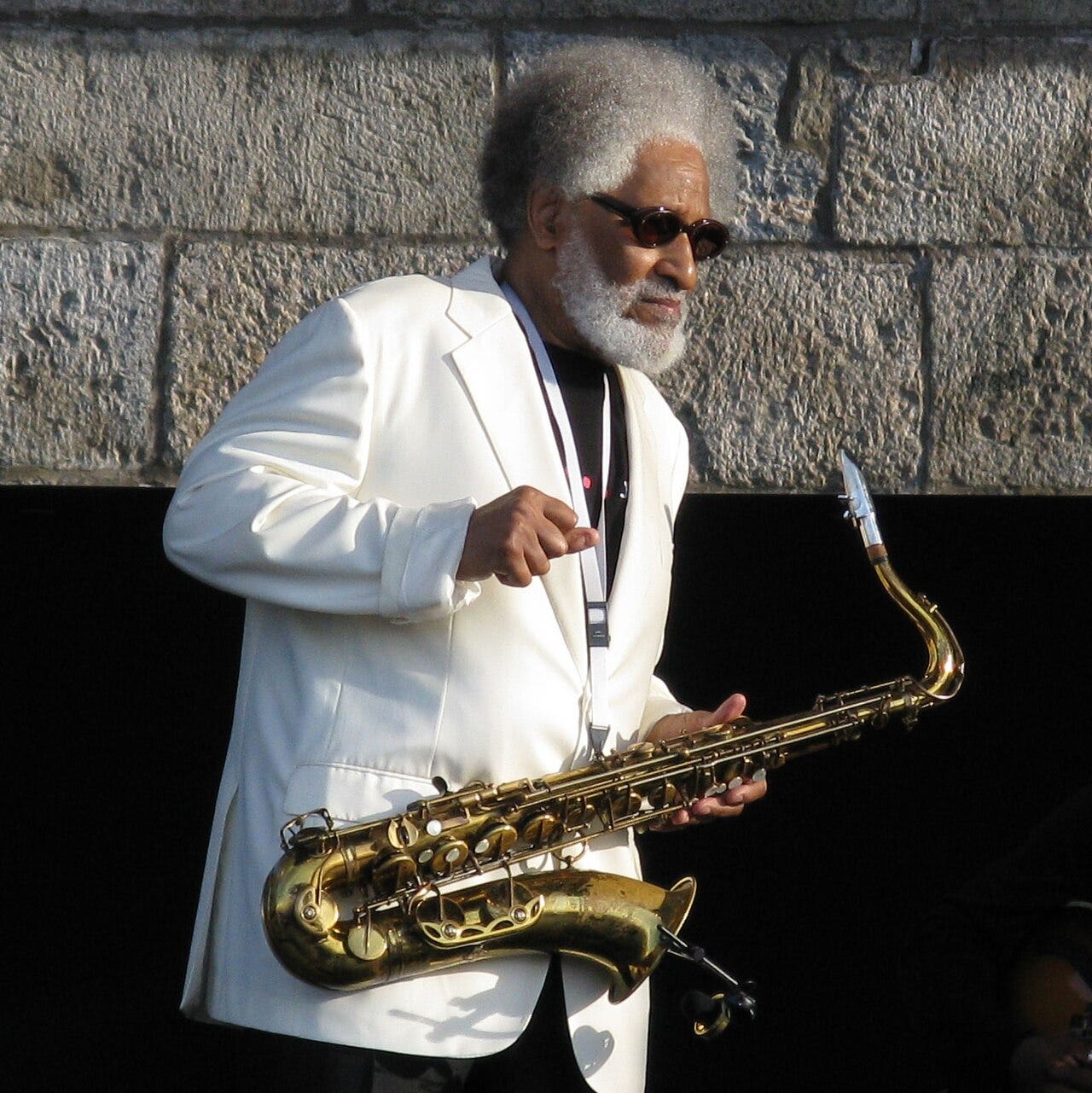
September 11th
“There is a spirit in all music, the spirit has the ability to conjure up thoughts even pictures of something that happened or you wished would happen or you anticipate happening. Music has the ability to create ideas . . . It has the ability to encourage us to be creative.” —Maya Angelou
On Friday evening, Sept. 14th, 2001—three days after the dark, still ambiguous events surrounding 9/11—I received a call from the music critic for one of the newspapers in Boston where I lived at the time. My friend had plans to attend a Sonny Rollins concert the following evening, as Rollins would be performing at the famed Berklee Performance Center on Massachusetts Avenue. He had an extra ticket and was inviting me to join him. “Are you kidding?” I exclaimed. I possessed scores of recordings documenting the trajectory of Rollins’s legendary musical career over the course of a rich, estimable life. After several days of watching the relentless newsfeed accosting us on all sides over the post-9/11 airwaves, it was evident that America was engaged in a redoubling of its own violent propensities and projective narratives underwriting a Manichaeism not unlike that having apparently underwritten the initial event. The writing, sadly, was on the wall: within the government and mainstream press, it would be stridency and tone-deaf chords all the way. Already one sensed a self-righteous march of retaliatory aggression from which the country has never meaningfully disengaged.
At the time, I was living not unlike Thoreau in a small cottage on the outskirts of Boston heated by a single wood stove. I was by and large unfamiliar with Rollins’s recent work, and the thought of witnessing a master of the form while escaping for a while the incessant spate of news and events in which tragedy segued into platitude and reprisal afforded a modicum of relief—moments of reprieve in the aftermath of calamity. The storied 9/11 concert would become another chapter in the overarching Rollins legend.
Sonny had been at home with his wife, Lucille, in their longtime flat in Lower Manhattan several blocks north of the World Trade Center when the planes struck that morning. Once evacuated, Sonny and Lucille left for their farmhouse in upstate New York. Rollins intended to cancel the performance but was persuaded by Lucille that the show should proceed. Following an emotional introduction on the night of the concert, Rollins offered humble, conciliatory words: “We’d like to start out with a number that I heard a long time ago when I was growing up—a version of one of my favorites, Paul Robeson. It’s very appropriate at this time. Of course, it’s appropriate in my life every day, but I think everybody feels this way. It’s called ‘Without a Song.’”
No doubt, Rollins was alluding to the madness of unfolding events, but perhaps he was recalling, too, a day in October, 1945 when Frank Sinatra (whose cover of the song was also well-known) and Nat King Cole visited the Benjamin Franklin High School in East Harlem to address a student assembly in the face of escalating tensions between Italian and Black youth that had erupted into riots in the streets. Sinatra and Cole jointly proffered messages of multicultural tolerance. “This country was built by many people of many creeds, so it can never be divided,” Sinatra admonished; “No kid is born and two days later says, ‘I hate Jews or colored people.’ He’s got to be taught.” The wisdom conveyed that day by Sinatra and Cole, no less than Rollins’s invocation of Robeson (a towering figure in the civil rights narrative of principled dissent), was directly relevant to the events erupting on 9/11 and the further bloodlust that ensued. “Frank was cool,” Rollins later recalled. “He understood what the cats were undertaking culturally. Frank had hung out with the brothers and sisters a lot, so he got to understand us more than most other white singers.”
Here is Rollins’s evocative opening number, “Without A Song”:
As Rollins introduced the members of his band (Perry Wilson on drums, Kimatia Dinizulu on percussion, nephew Clifton Anderson on trombone, comrade-in-arms Robert Cranshaw on bass, and an astonishing Stephen Scott on piano) during the course of the evening, he offered this counsel: “We must remember that music is one of the beautiful things of life, so we have to try to keep [it] alive in some way.” “Tragic insight,” Nietzsche somewhere cautions, “requires art as protection and remedy.”
The penultimate tune was an adaptation of Jerome Kern/Oscar Hammerstein’s ballad “Why Was I Born?” (Rollins’s tastes were exceptionally wide-ranging, and he had a longstanding love affair with the ballad) with fittingly existential lyrics:
“Why was I born? Why am I living? What do I get? What am I giving?” —Jerome Kern and Oscar Hammerstein, “Why Was I Born?”
Themes upon which the contemplative jazzman had been meditating for years. The audience was transfixed by the thrilling performance set against the macabre backdrop of recent events. An outpouring of musical dialogues and visions on exquisitely rarified planes. A juxtaposition of some of humankind’s sublimest virtues and values with some of its basest. At the end of the evening, I turned to my friend and said, “That has to have been one of the best live performances you’ve ever heard.” The music critic, I understood, had attended countless concerts over the course of his career. He paused briefly before affirming my suspicion: “Yes, it was.”
Global Warming
“Artists are the radical voice of civilization.” —Paul Robeson
“Global Warming” is the name of the second song Rollins elected to play at the 9/11 concert. It is, coincidentally, the title song of a 1998 release on the Milestone label. Counter-intuitively, the song is a joyous embrace of existence. A pensive musician of unusual depth and goodwill urges awareness as a sort of prelude and subtext to his music notwithstanding an occasionally ironic titling of tunes. Rollins had a message, to be sure, though he intended no heavy-handedness for fear of putting unsuspecting listeners too quickly off. Concerning the title track, Rollins reflected: “The song was meant to be not necessarily about global warming . . . It wasn’t a sad song.” Another composition on the album, “Echo-Side Blue” was, in fact, “more descriptive, more plaintive” concerning Rollins’s thoughts about “an impending destruction of the planet.” Feeling that the original title, “Ecocide Blue,” might have been “a little too stark for the people,” Rollins mitigates somewhat the song’s final designation. In this way, a thematic imperative coalesces, cumulatively, around the globe’s radical detachment from Nature and Sanity. “It’s good to be enlightened,” Sonny wryly observes.
Like Parker and Coltrane, Rollins was a highly intelligent, well-read man. ”I read a lot of Noam Chomsky, Howard Zinn, Michael Parenti,” he commented at the time. “They’re all about the environment, this impending disaster we’re heading into.” (The doomsday clock, set since January to a scant 85 seconds before midnight, becomes now, according to The Guardian, the “new abnormal.”) Rollins’s observations are tinged with Eastern sagacity: “It’s incumbent upon us as sentient beings to do what we can.” Here, too, his message is stated without pretense or adornment. Expressed musically, we each have our “part to play.” “And we try; it doesn’t mean we have success.” Rollins ponders, forebodingly, “the profligate use of things;” “the way we use energy and things—that’s the sin.” “I want to live lightly on the planet—I’d rather think of myself as a spirit than a body.” Consortium readers may wish to check out this 2006 interview on pressing planetary themes:
Moving towards the unconscious
“One must have chaos within oneself to give birth to a dancing star.” —Friedrich Nietzsche, Thus Spake Zarathustra
“Creativity arises out of the tension between spontaneity and limitation, the latter (like the river banks) forcing the spontaneity into the various forms which are essential to the work of art or poem.” —Rollo May, The Courage to Create
“What is courage?” Rollo May muses in a lovely collection of essays, The Courage to Create—a sort of guide for living he once wrote for undergraduates while teaching a course at Princeton University. May distinguishes between physical, moral, social, and creative courage, observing: “Any theory of ‘resistance’ that omits the terror of human consciousness is incomplete and probably wrong.”
Rollins faced innumerable challenges throughout life, both pedestrian and esoteric. This would seem to be an inevitable concomitant of the surpassingly generative existence. A radically dysfunctional society; consuming superficiality, materialism, violence, and injustice; an apparent dearth of bona fide guides and beacons of light; the myriad setbacks along the way. Rollins’s recurring disappearance acts followed by startling resurgences in pursuit of higher spiritual and aesthetic rungs. A steadfast, seemingly sacrosanct, honoring of musical compatriots who didn’t always make it to the other side. (The highway of jazz is littered with the corpses and shimmering pearls of high art.) And, pervasively, the muse of music and ongoing explorations in search of further dimensions of being and sound. What James points to, in Principles of Psychology, as “this unfinished-seeming front.”
Psychologists speak volubly these days about “creativity” and “depth,” though the attributes themselves, as Maslow came increasingly to realize, are complex and, in professional circles, rarely embodied or attained. (“I don’t want to call it plagiarism,” lamented Rollo’s wife, Georgia, shortly before she died, “but where’s the [truer] creativity?”) There are no Rollo Mays any longer on the scene. Restive, earnest searching would seem to be the crucial thing—something very different from “copyism” or what essayist/novelist Milan Kundera calls “imagology”: an acutely modern phenomenon in which image is manufactured, managed, bought and sold through advertising, fashion, and public relations. Copyism is typified by its derivative nature with old wines poured into new wineskins often without attribution of any sort. Displays of mock-authenticity pose as originality and advance. Jamesean “unmanageables” like myself (and, I think, Rollo May too) seek, rather, those rare Nietzschean “free spirits” who “not only speak differently” but “also are different”—those “wise, silent ones in the corners,” as May himself put it upon our first meeting many years ago. Rollins was invited onto the bandstand with Charlie Parker, Thelonious Monk, and Miles Davis because he knew the liturgy extremely well and had something uniquely his own to contribute and convey.
May, as I understand it, struggled with loneliness, despair, and episodic depression over time. These latter episodes were described as periods of “nervous exhaustion.” They were counterbalanced, notes his biographer, Robert Abzug, by a more enduring constitution typified by “boundless energy,” suggesting a cyclothymic temperament overall. Bob notes, informally, a family history described by Rollo’s half brother, Gerald (a psychiatrist and popular author of books in the area of spiritual psychology) of mood disturbance dating back for generations. The Meaning of Anxiety, May’s doctoral dissertation originally published in 1950, explores the affect central to his thought. A preponderance of depressions, we learn from Nassir Ghaemi, are “mixed” in nature and accompanied by hypomanic or manic aspects simultaneously. Anxiety is a regular feature of such states. The term “nervous exhaustion” evokes this mixed presentation and experience very well. The profundity of May’s work, like that of James and Rollins, was informed by pervasive mood lability, restlessness, and travail.
May’s exhortations concerning the differences between artifice and bone fide art are instructive here, and Rollins, like May, was a consummate creator. The myriad band formations, the spellbinding conversations among a plethora of players, the ongoing explorations of selves and worlds well into old age. The error of self-anointed “experts” lies in limited insight and vision, incessant self-promotion, and insufficient honoring of Nietzschean “dancing stars.” Think of William James or Ellington; think of Nina Simone, Abby Lincoln, or the ethereal Sarah Vaughan. Think of Coltrane and the short-lived seraph Clifford Brown whose early Prestige recordings with Rollins are sublime. So far as I’m aware, organizational psychology hasn’t anything on offer remotely like this in the way of creativity or depth.
Due to physical complications as he aged, Sonny found himself eventually unable to play his horn—a loss about which he spoke wistfully while continuing to live with mindfulness and style. I find myself listening these days to Rollins recordings made over a span of more than sixty years, recalling a friend who once wondered: “If my favorite tenor saxophonist is Coleman Hawkins, why am I always listening to Ben Webster?” Lately, I feel this way about Coltrane and Rollins. Both are paragons worthy of reverence—spiritual compatriots who kept their appointments in these all-too-visible realms and those imagined ones beyond. Higher orders of being proffering complementary messages, offerings, any prayers to those within hearing distance. Such beings serve as stirring embodiments of what is possible in the way of refinement of consciousness and human endeavor over time. “As for my spiritualism,” reflects Rollins in a late interview, “it’s more an amalgamation of my religious convictions. I am trying to clean up my karma so that I can come back with the blessings of the Great Spirit.” As the ancient Arabic/Judaic expression would have it, “From [his] lips to God’s ears.”
Musical coda
Time, we all know, is fleeting. Here I have preserved just a few moments as a sort of testament to, and benediction for, Rollins’s graceful, distinguished sojourn on planet earth. Jamesean waves from some cosmic sea breaking upon troubled earthly shores. Gnostic fragments intended for those within within earshot who, as Jamesean scholar and personal friend Eugene Taylor wrote shortly before his own demise, “glimpse the inmost core”:
One of the numerous latter iterations of Rollins’s band with Rollins on tenor sax, Clifton Anderson on trombone, Bob Cranshaw on bass, Steve Jordan on drums, Kimati Dinizulu on percussion, and Bobby Broom on guitar. This performance of “Global Warming” took place during the 2005 Jazz à Juan festival in Antibes:
References
Abbott, J. & Blumenthal, B. (2009). Saxophone Colossus: A Portrait of Sonny Rollins. Abrams.
Chinen, N. (2018). Playing Changes: Jazz for the New Century. Pantheon Books.
James, W. (1908). The Varieties of Religious Experience: A Study in Human Nature. Longmans, Green, and Co.
James, W. (19 50). The Principles of Psychology. Dover.
May, R. (1969). Love and Will. Norton and Co.
May, R. (1975). The Courage to Create. Norton and Co.
Mendelowitz, E. (2019). Global Warming: The Universal Mind of Sonny Rollins. Society for Humanistic Psychology Newsletter.
Nietzsche, F. (1954). The Wanderer and His Shadow. In The Portable Nietzsche (W. Kaufmann, trans.). Viking Press.
Rollins, S. (1998). Global Warming. Milestone Records. [CD]
Rollins, S. (2005). Without a Song: The 9/11 Concert. Milestone Records. [CD]
Rollins, S. (2016). Holding the Stage: Road Shows, Vol 4. Sony Masterworks. [CD]
Wyatt, H., (2018). Sonny Rollins: Meditating on a Riff. Kamama Books.
Photo credit
Creative Commons Attribution-Share Alike 3.0