
Transience and Possibility
The Legacy of Rollo May

This briefest reverie on transience and possibility is a collage-like piece admixing bits of poetry, dream, image, and prose. Elliptically, it reflects on the legacy of preeminent psychoanalyst and author Rollo May, honoring the matrix of thinkers out of which his work emerges even as it suggests, simultaneously, his hallowed place amid a present-day cacophony of derivative voices and minds. In an earlier appearance as featured presentation at a conference in Nanjing, its intended purpose was two-fold: a poetic introduction for Eastern colleagues to an authentic Western sage; and a challenge to the West to more resolutely embody the courage to be and create that May saw as foundational to the prospect of becoming more fully human. Message and form, as a consequence, are intricately interwoven.
William Barrett, in his book Irrational Man, begins with an anecdote related by Søren Kierkegaard, the philosopher and religious thinker sometimes known as the “melancholy Dane.” ‘‘The story is told,’’ writes Barrett, ‘‘of the absent-minded man so abstracted from his own life that he hardly knows he exists until, one fine morning, he wakes up to find himself dead.’’ We could, each of us, Barrett warns, wake up at any moment to find ourselves restored to the beyond without ‘‘ever having touched the roots of our own existence.’’ This story underscores an essential aspect of what we may recognize as an existential or, better perhaps, post-existential, frame of mind: a sense of living too much on the surface of things without taking sufficient account of the myriad dimensions of experience whirring about everyday consciousness.
Such a sensibility is, in fact, omnipresent in human being and experience yet especially prevalent in times of dislocation or crisis. William James, in Varieties of Religious Experience, writes of a ‘‘horrible fear’’ in youth of his own existence. And so, an enhancement of experience and consciousness that may evolve as a consequence of maturation, adversity, and matter of course into broadened purview and greater awareness. “A crisis is needed,” observes Rollo May.
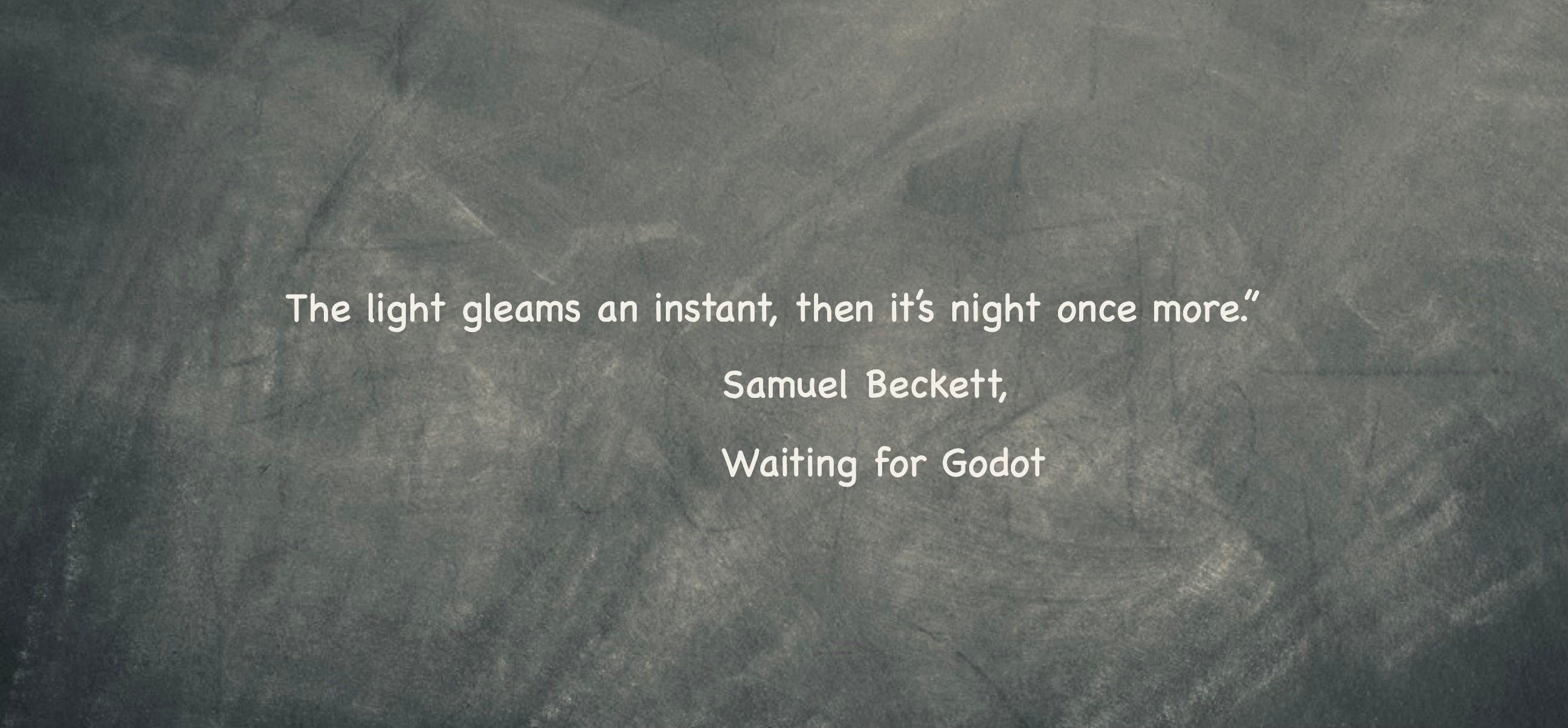
Existence: from the Latin “to stand forth,’’ ‘‘to emerge.’’ Rollo May never tired of pointing to the hidden, often nuanced, meanings embedded in words.
“When I consider the short duration of my life, swallowed up in the eternity before and after, the small space which I fill, or even can see, engulfed in the infinite immensity of spaces whereof I know nothing, and which know nothing of me, I am terrified and wonder that I am here rather than there, for there is no reason why here rather than there, or now rather than then.”
— Blaise Pascal, Pensées
“Who am I? How did I come into the world? Why was I not consulted? . . And if I am to be compelled to take part in it, where is the director? I should like to make a remark to him. Is there no director? Whither shall I turn with my complaint?”
— Soren Kierkegaard, Repetition: An Essay in Experimental Psychology
Pascal distinguishes between an “order of mind” (one proceeding with “principles, demonstrations”) and a counterposing “order of heart” (one taken up “mainly in digressions upon a sequence of points yet related in the end—something always to be held in view”). Such an articulation of things is succinctly expressed by the late psychoanalyst and psychiatrist Allen Wheelis, one of the finest writers the avowedly “helping” professions have ever known:
“A symphony has a climax, a poem builds to a burst of meaning, but we are unfinished business. No coming together of strands. The game is called because of darkness.”
— Allen Wheelis, The Listener
And, so, a psychology/philosophy situated in transience and mindfulness—what May liked to call ‘‘a sense of being,” ‘‘the ontological sense.’’
Otto Rank and the trauma of birth
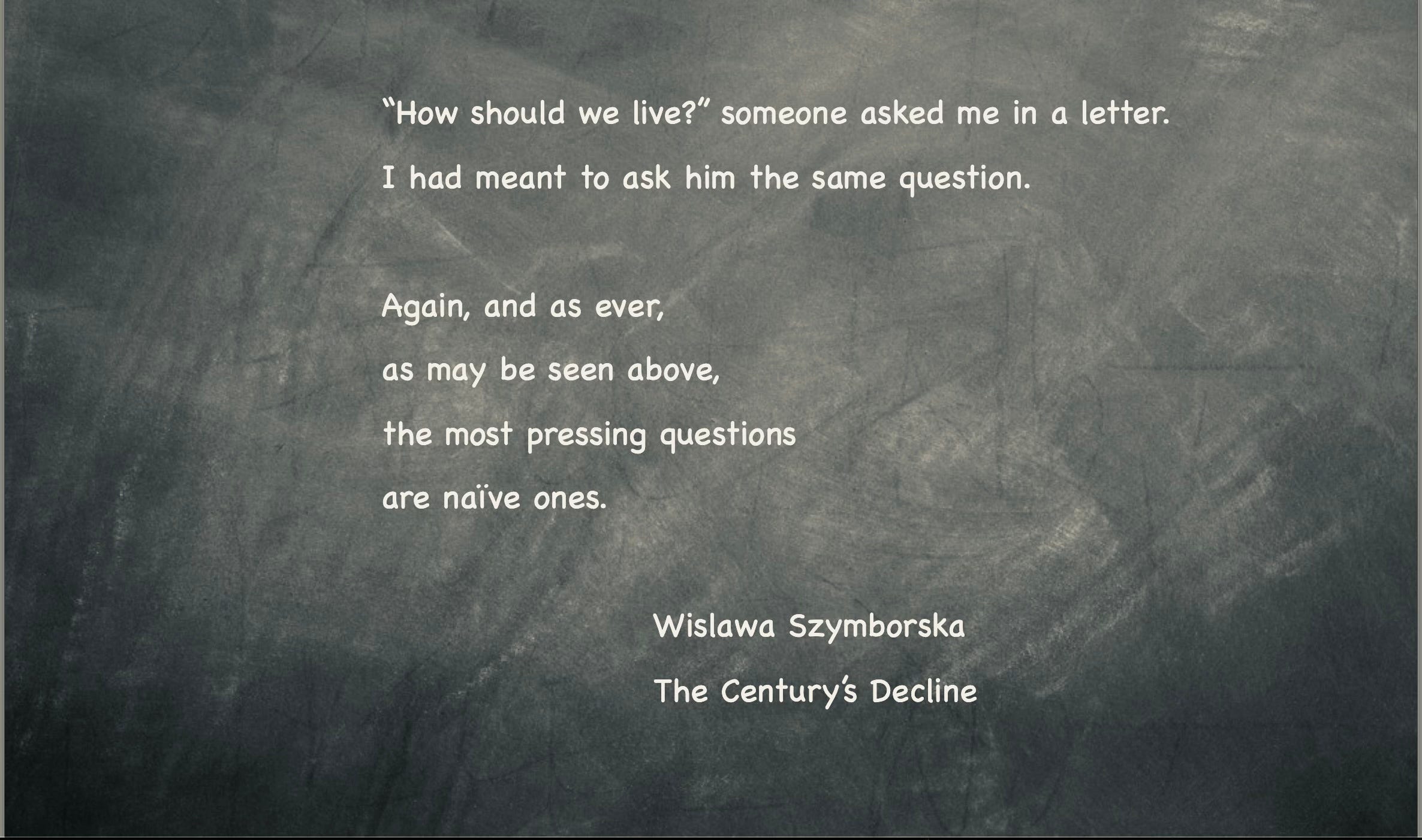
Ontology,” from the Greek word for “being” suggesting the study, even telling, of being. For Freud, anxiety has biological origins and is a consequence of the clash between civilization and instinct. Karl Jaspers is, perhaps, the more astute psychologist in underscoring the “fragility of being.’’ We note, too, Samuel Beckett’s ‘‘suffering of being’’ connoting the frail, mortal specimen who suffers, so to speak, from overexposure. The human dilemma resides precisely in the fact that we know too much about a quandary that can never be wholly redeemed. The greater the awareness, the greater the dread and eventual debt. For Otto Rank, life is best understood as a series of ongoing separations and unions and the resultant vacillations between fear of life and fear of death. Life, suggests Rank, is a “loan” (different from a “gift”) with death the repayment. All loans are to be paid, eventually, in full.
In an early essay on the “artist-type,” Rank selects a line out of Shakespeare to make his point:
‘‘Is it possible that he should know what he is, and be that he is?’’
—William Shakespeare, All’s Well That Ends Well
‘‘While not disputing the ‘truth’ of biology,’’ writes Rankian scholar Robert Kramer, ‘‘Rank peers underneath biological bedrock to confront the ontological mystery of Being itself: the awesome and ineffable difference between nonexistence and existence.’’ We are, Rank notes, ‘‘theological things,’’ forever seeking apotheosis or refuge in some sort of system or beyond. How to coexist with what Earnest Becker calls “the lived truth of creation’’? It’s a matter of considerable urgency these days especially, as so few among us appear to get things even remotely right.
Becker’s cogent statement of the human dilemma:
“Man has a symbolic identity that brings him sharply out of nature. He is a symbolic self, a creature with a name, a life history. He is a creator with a mind that soars out to speculate about atoms and infinity . . . This immense expansion, this dexterity, this ethereality. . . gives to man literally the status of a small god in nature, as the Renaissance thinkers knew. Yet . . . as the Eastern sages also knew, man is a worm and food for worms. This is the paradox: he is out of nature and hopelessly . . . in it; he is dual, up in the stars and yet housed in a heart-pumping, breath-gasping body that once belonged to a fish and still carries the gill-marks to prove it.
— Ernest Becker, The Denial of Death
The meaning of anxiety
And then there is Rollo May, for whom the centrality of anxiety in experience and consciousness is key. It’s there from the start. We could say, perhaps, a few words about May’s anxious beginnings, about May and tuberculosis and family dysfunction and, perhaps as a consequence, his abiding struggle with both self and the world:
‘‘Anxiety is not an affect among other affects such as pleasure or sadness. It is rather an ontological characteristic of man, rooted in his very existence.’’
—Rollo May, The Meaning of Anxiety
“Art is the symbol of the two noblest human efforts: to construct and to refrain from destruction.”
—Simone Weil, Gravity and Grace
Although Rank and Becker may appear, at times, to emphasize the ‘‘darker’’ aspects of existence, May underscores the paradoxical benefits of awareness while lamenting the ‘‘repression of the ontological sense’’ characterizing so much of American society in particular. ‘Temporality,’’ he writes in Love and Will, ‘‘is what makes care possible.’’ As I remember him, May embraced philosophical, literary, aesthetic, and spiritual aspects of being in equal measure. Lightyears beyond the “well-adjusted” American, May (a midwesterner, no less!), hit, like a painter or musician, on seemingly all conceivable pigments and notes. “If you’re well-adjusted,” I remember him saying, “you will never make a good therapist. You won’t make a good anything. Maybe a good soldier.”
Paradox and the integration of elements
Mindfulness of being can lead to what is especially sublime in human existence. To anxiety, certainly, and even despair. Yet also to mystery, fellow feeling, and the search for some sort of meaningful coherence or resolution or—at a minimum—occasional moments of reprieve: what May calls, movingly, “the charm of mortality.’’ And when pursued diligently, to a “sense of self”—Nietzsche’s ‘‘nobility of soul’’ and ‘‘order of rank.” A difficult embrace of the terror and beauty of life. ‘‘A twice-born philosophy,’’ suggests William James.
The world according to Irish essayist Thomas Carlyle is both ‘‘mystic temple’’ and ‘‘hall of doom.’’ Such insight gives rise to a feeling of uncanniness, no doubt, but also to acknowledgement, resoluteness, and wonder. A spiritual sensibility often found wanting in organized religions with their oftentimes doctrinaire formulations, alluring spokespersons, in-groups and out-groups, and self-serving beliefs. ‘‘It is the failure of therapy,’’ May admonishes in Love and Will, ‘‘rather than its success, when it drugs the daimonic, tranquillizes it, or in other ways fails to confront it head on.’’
Encounter: Lynchpin of change
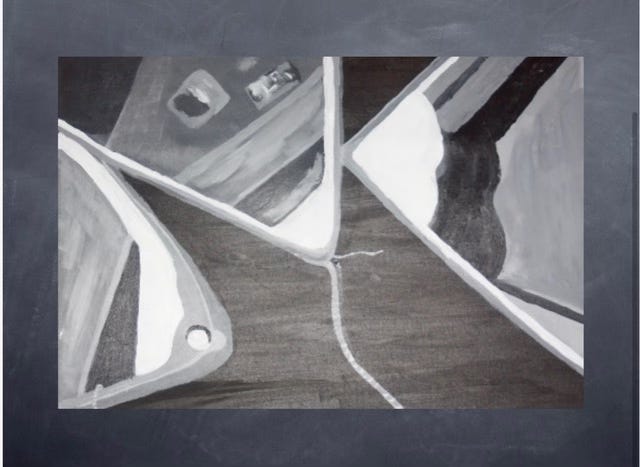
I-Thou “encounter,” for Rollo May, is the touchstone of effective psychotherapy and change, with “technique” routinely clutched desperately as ‘‘protection from consciousness.’’ Here is Kristyna’s evocatively modernist dream:
“Basically the dream was about a robot that looked human and took my place in the world. I don’t remember the plot, just that it took over for me. No one could tell I was gone. “
—Cited in Ed Mendelowitz, Ethics and Lao -Tzu: Intimations of Character
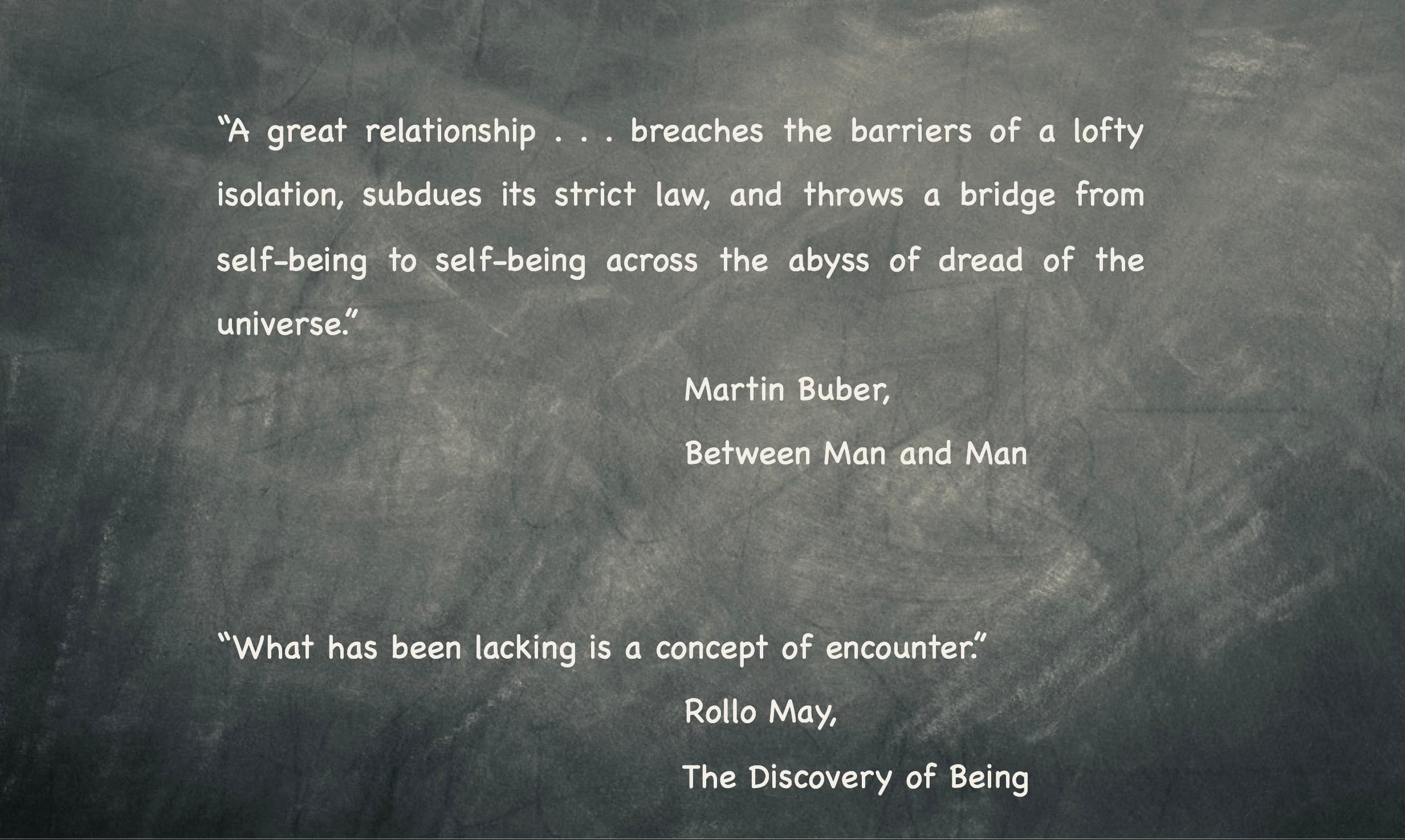
“A great relationship. . . breaches the barriers of a lofty isolation, subdues its strict law, and throws a bridge from self-being to self-being across the abyss of dread of the universe.”
— Martin Buber, Between Man and Man
“Society is the cave. The way out is solitude.”
—Simone Weil, Gravity and Grace
“It is a state composed of the recognition of another, a fellow human being like one’s self; of identification of one’s self with the pain or joy of the other; of guilt, pity, and the awareness that we all stand on the base of a common humanity.”
— Rollo May, Love and Will
The emphasis is upon the phenomenological moment, the connection between self and other—this as opposed to the bracketing of another according to preconception or blueprint. “Everything beautiful,” writes Weil, “has a mark of eternity.” Encounter beyond objectification of symptom or other and, in this way, movement as a sequence of ongoing acts of individual consciousness and will.
“We cannot solve many problems, and there are the world and the stars to dwarf us and give us some humor about ourselves. But we can hope that, with some of the feeling of what Martin Buber calls ‘I-Thou’’. . . there may be more friendliness about us. This would be no small happening, and it is for this that we must work. Really, there is much less to say than to affirm by living.”
— Robert Coles, The Mind’s Fate
Psychological theory is, in a sense, a collection of projections of the inquiring mind itself—attempted reformulations of the apparent chaos of things (James’s ‘‘big, blooming buzzing confusion’’) into makeshift coherence. We are more than our instincts, more than our cognitions, more even than our archetypes or genetic codes; certainly, we are more than the behavioral sequelae of stimulus and response. There is always, insists James, something unknown, something hidden, something “more.” “Human progress,” echoes May, “is never one-dimension.”
Self-realization, ‘‘a great and rare art’’
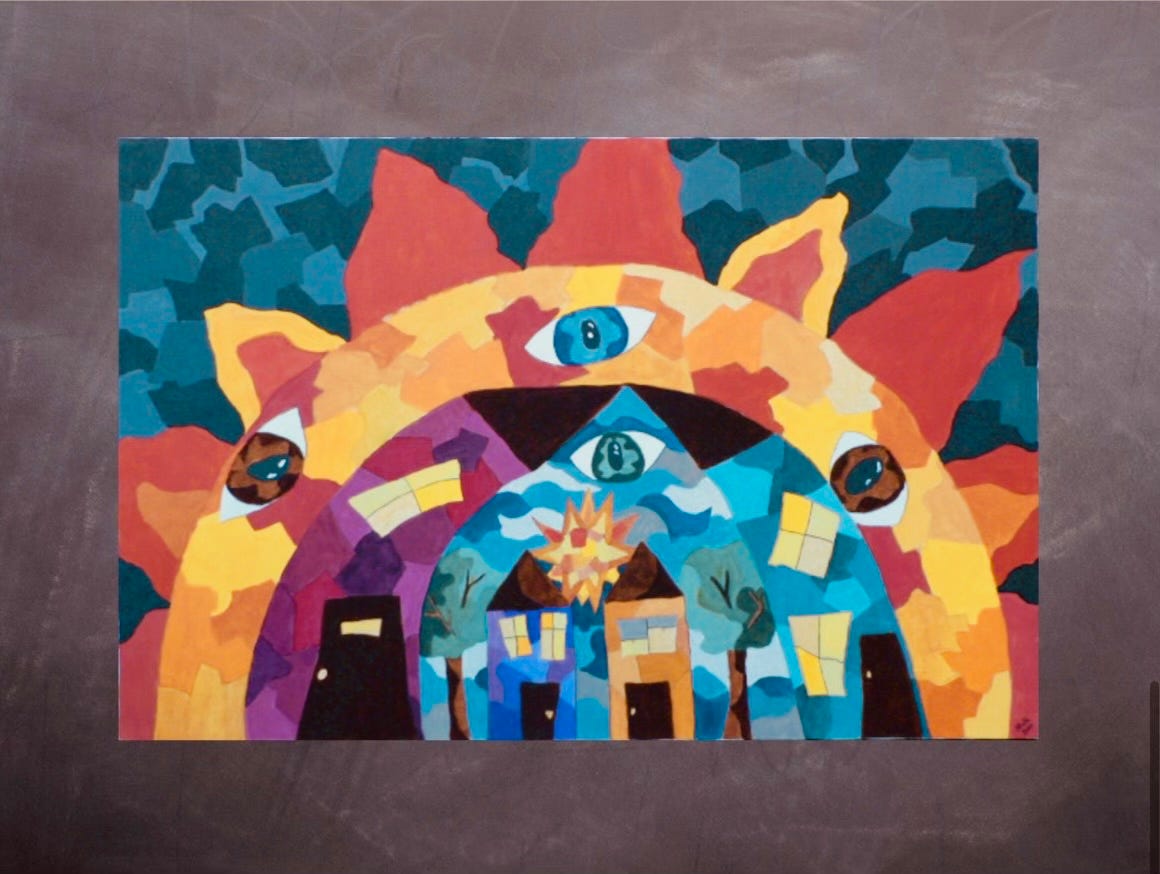
‘How one becomes what one is,’’ exhorts Nietzsche in his memoir, Ecce Homo, words said to have been uttered by Pontius Pilate upon tuning a thorn-crowned Jesus over to the crowd. ‘‘Giving style to one’s character, a great and rare art.’’
“Man is a rope, fastened between animal and Over[person]—a rope over an abyss.”
— Friedrich Nietzsche, Thus Spake Zarathustra: A Book for and None
“Creative attention,” observes Weil, “means really giving our attention to what does not exist.”
—Simone Weil, Gravity and Grace
“We express our being by creating. . . . We must always base our commitment in the center of our own being or else no commitment will be ultimately authentic . . . Courage is necessary to make being and becoming possible.”
— Rollo May, The Courage to Create
May invokes what French philosopher, playwright, and music critic Gabriel Marcel calls a ‘‘metaphysics of hospitality.” One learns from all available sources yet, upon crossing a threshold, leaves them at the door and humbly finds one’s particular way.
Transience and possibility
“Step out of your cave: the world awaits you like a garden. . . All things would be your physicians.”— Friedrich Nietzsche
“History is a tissue of base and cruel acts in the midst of which a few drops of purity sparkle at long intervals.”—Simone Weil
“The ultimate paradox is that negation becomes affirmation.”— Rollo May
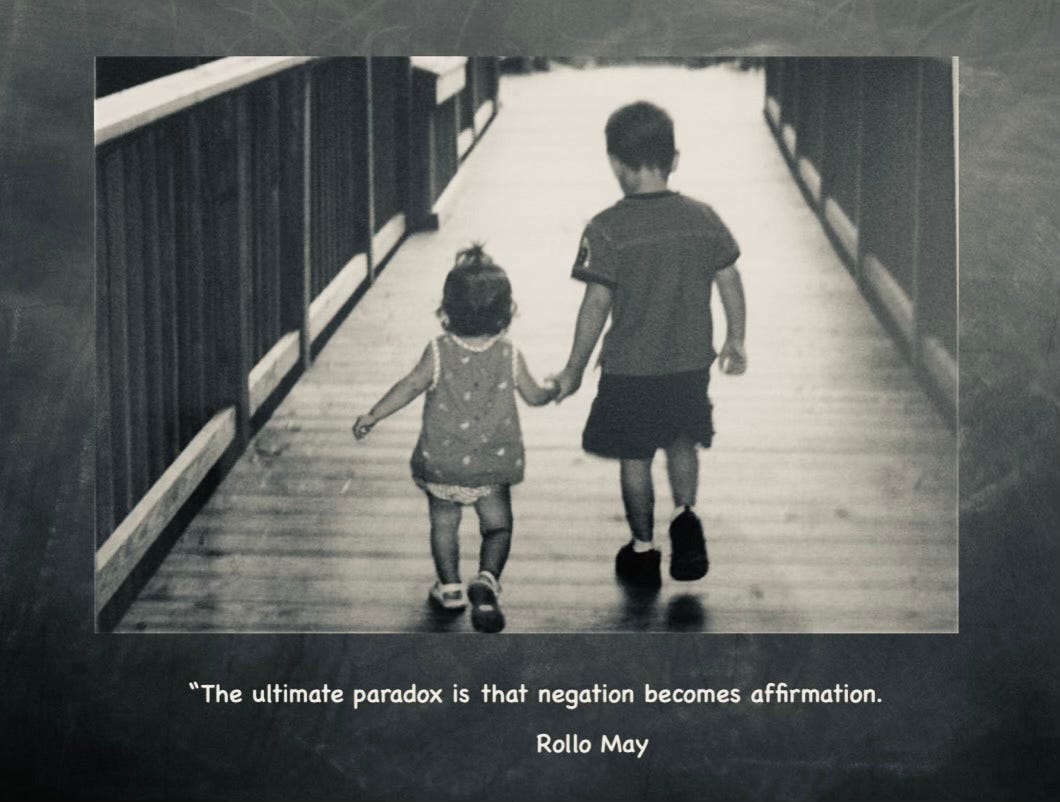
Transience and possibility, do you see?
Musical Coda
Charles Mingus, “Sue’s Changes,” Live at Montreux, 1975. Mingus on bass, George Adams on sax, Jack Walrath on trumpet, an astonishing Don Pullen on piano, and Mingus’s longstanding comrade-in-arms, Dannie Richmond, on drums:
Art credits
All photography and artwork are reproduced courtesy of Kristyna, whose heartrending and multifarious stories are narrated more fully in an out-of-print book entitled Ethics and Lao-Tzu: Intimations of Character. Jung observes that our finest teachers are encountered in those forbidden spaces and asylums more often than among a professional or intellectual elite. Careful readers will discern that we have much to learn from the words and images regularly forthcoming from Kristyna’s uncommonly perceptive mind.
References
Barrett, W. H. (1962). Irrational man: A Study in Existential Philosophy. Anchor Books.
Becker, E. (1973). The Denial of Death. Free Press.
Buber, M. (1965). Between Man and Man. Macmillan.
Coles, R. (1995). The Mind’s Fate: A Psychiatrist Looks at his Profession. Little Brown & Company.
James, W. (1905). The Varieties of Religious Experience. Longmans, Green, and Co.
James, W. (1948). Psychology: The Briefer Course. Living Library.
Keats, J. (2004). The Sixty-Four Sonnets. Paul Dry.
Kierkegaard, S. (1980). “Repetition: A Venture in Experimenting Psychology. “In H. V. Hong & E. H. Hong (Eds.), The Essential Kierkegaard. Princeton University Press.
Kramer, R. (1997). “Otto Rank and ‘The Cause.’” In T. Dufresne (Ed.), Freud under Analysis: Essays in Honor of Paul Roazen. Jason Aronson.
Marcel, G. (1962). “The Mystery of Being.” In J. T. Wilde & W. Kimmel (Eds.), The Search for Being: Essays from Kierkegaard to Sartre on the Problem of Existence. Noonday Press.
May, R. (1969). Love and Will. Norton & Company.
May, R. (1975). The Courage to Create. Norton & Company.
May, R. (1979). Psychology and the Human Dilemma. Norton & Company.
May, R. (1981). Freedom and Destiny. Norton & Company.
Mendelowitz, E. (2008). Ethics and Lao-Tzu: Intimations of Character. University of the Rockies Press.
Mingus, C. (2018). Live at Montreux, 1975. Eagle Rock. [CD]
Nietzsche, F. (1954). “Thus Spake Zarathustra: A Book for All and None.” In W. Kaufmann (Ed. & trans.), The Portable Nietzsche. Viking Press.
Nietzsche, F. (2004). Ecce Homo (A. M. Ludovici, Trans.). Dover Publications.
Rank, O. (1978). Will Therapy. Norton & Company.
Weil, S. (1997) Gravity and Grace (A. Wills, trans.). University of Nebraska Press.
Wheelis, A. (1999). The Listener. Norton & Company.